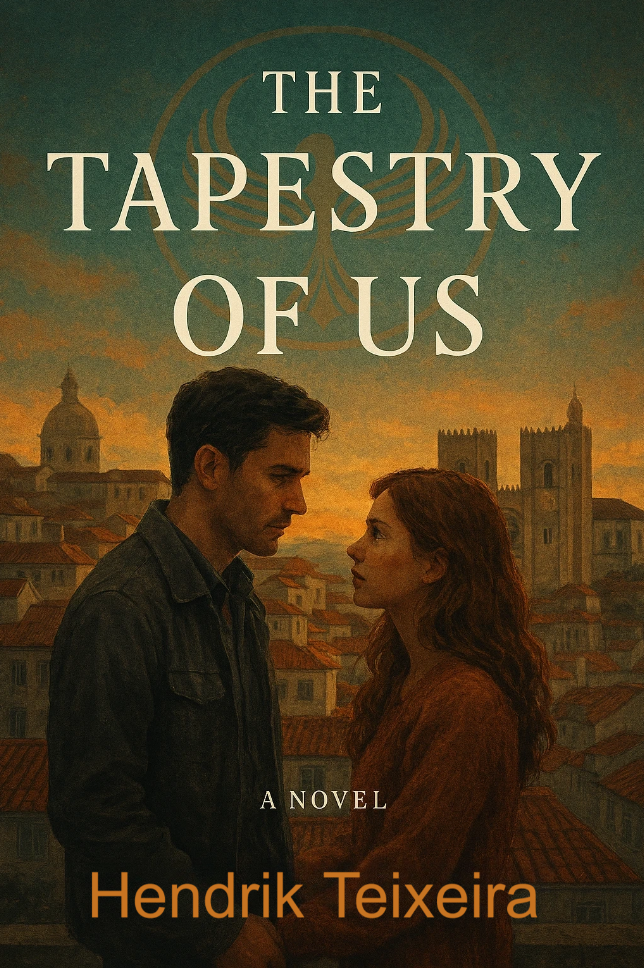
Book 1
The Tapestry of Us
Book One
A chance meeting in Kyiv changes everything. Two worlds, one destiny, and one unforgettable journey begin inside a café where love first becomes possible.
Buy this book in your country
Your local Amazon store is highlighted automatically. If no local store is matched, Amazon US is shown first.
Ukrainian books are shipped from Ukraine directly and may take a little longer due to the ongoing conflict.
Book 1
Chapter One Audiobook
The Tapestry of Us
Listen to the opening chapter. Progress is saved in this browser.
Start Listening
Free Read
Chapter One
Read Chapter One
Chapter One — Hendrik
Kyiv, The City of First Steps
The cold struck me first.
Not the kind of cold I knew from Lisbon’s winters — soft, wet, almost apologetic — but a sharp, crystalline cold that felt ancient, as though it had been waiting centuries just to greet me. Kyiv’s winter air carried a clarity that cut straight through the layers of my coat and into my bones, but instead of discomfort, I felt something else entirely.
I felt awake.
Snowflakes drifted down in slow spirals, each one catching the streetlamps and scattering their light like tiny shards of glass. They landed on my coat, on my gloves, on the worn leather of my suitcase. I paused beneath the towering silhouette of St. Sophia’s Cathedral, its gilded domes glowing like suspended suns against the twilight sky, and for a moment I simply breathed.
Fifty-four years of life behind me, and yet I had never felt so much like a man standing at the beginning of something.
My boots pressed into the cobblestones — uneven, ancient, alive with history — and I felt the weight of the city beneath my feet. Kyiv was not a place one merely visited. It was a place that demanded presence, demanded attention, demanded reverence. Every corner hummed with memory. Every building seemed to lean in, whispering stories of saints and soldiers, poets and lovers, triumph and tragedy.
And I, Hendrik Teixeira, a man who had spent decades measuring his steps and tempering his impulses, felt strangely at home in its intensity.
I had come here with a purpose — a scholarly one, I told myself. To study the symbols woven into Ukrainian embroidery, the protective dragons and serpents carved into wood, the ancient motifs that had survived wars, occupations, and time itself. But beneath that academic pursuit lived a quieter truth: I had come because something in me was restless. Something in me was searching.
For what, I did not yet know.
The cold air filled my lungs, sharp and invigorating. I could smell freshly baked varenyky from a nearby stall, the smoky scent of klyonky roasting over open flames, the sweetness of pastries cooling on windowsills. Laughter spilled from taverns. Music drifted from distant courtyards. The city was alive, vibrant, unapologetically itself.
And I — a foreigner, a man with silver creeping into his hair and decades etched into his skin — felt strangely welcomed.
I walked slowly, deliberately, letting the city reveal itself to me. My blue eyes — eyes that had watched the Atlantic crash against Lisbon’s cliffs, eyes that had seen love and loss, beginnings and endings — took in every detail. The snowflakes clung to my eyelashes. The cold reddened my cheeks. And yet, beneath it all, a warmth stirred in my chest.
A sense of possibility.
A sense that something was waiting for me here.
I turned a corner and stepped into Market Square. Lanterns hung from wooden beams, casting warm pools of light over the bustling crowd. Children chased each other through the snow, their laughter rising like bells. Elderly couples strolled arm in arm, wrapped in thick coats and memories. Vendors called out their wares — embroidered shirts, carved toys, porcelain figurines painted with folklore scenes.
I stopped at a stall selling vyshyvanka shirts. My fingers traced the golden thread of a dragon motif — the same serpent I had studied in Lisbon’s archives. A symbol of protection. A guardian spirit.
The embroidery shimmered beneath my touch, as though acknowledging me.
“Ah,” a voice said beside me, warm and knowing. “You have an eye for the traditional.”
I turned to see an elderly woman with a kind face and eyes that sparkled with the wisdom of someone who had lived through both hardship and joy. She smiled at me, and in that smile I felt something shift — a small, subtle confirmation that I was exactly where I needed to be.
“This dragon,” she continued, touching the fabric with reverence, “is one of our most sacred symbols. It watches over those who carry it.”
I nodded, feeling a strange sense of connection — not just to the symbol, but to the city itself. To its history. To its people. To something I could not yet name.
I thanked her and continued walking, the snow crunching softly beneath my boots. The city unfolded before me like a story written in light and shadow, in cold air and warm hearts. And with every step, the restlessness inside me softened, replaced by a quiet certainty.
Something was coming. Something important. Something that would change the course of my life.
I didn’t know her name yet. I didn’t know her face. I didn’t know that she was already here, somewhere in this city, breathing the same cold air, carrying her own storms and secrets.
But I felt her. Like a whisper in the wind. Like a thread tugging gently at the edge of my soul.
Kyiv had brought me here for a reason.
And soon — very soon — I would understand why.